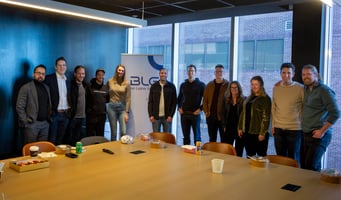
Philippe Burns, Co-Founder, Tech Thursday
Philippe Burns, Co-Founder of Tech Thursday, met with me last week to talk his time with Skip The Dishes and Neo, building Tech Thursday & it's role, and about Calgary's Tech Ecosystem.
Tech Thursday connects Canada’s boldest innovators, entrepreneurs, and tech leaders through transformative events and media that drive productivity, scale startups, and turn local talent into global impact.
Who is Phil?
Phil is a fun guy, a jovial guy. I run a company called Tech Thursday, which brings the tech community together every week in Winnipeg and Calgary, and a couple times a month in Edmonton and Ottawa. I also run a nonprofit called the Patrol Foundation with my buddies.
The Patrol Foundation raises money for select charities and throws fun parties. We just became, or at least we're very close to being, the largest community fundraiser for the Alberta Cancer Foundation in Southern Alberta, which is very exciting.This year we raised about $15,000 for the Balance Foundation, which supports local kids' sports. So far we're sitting at about $120,000 for Alberta Cancer Foundation, give or take a few thousand.
You were at Skip the Dishes pretty early on, how did that come about?
I was 17, in high school, doing a bit of coding and my brother knew the founders of Skip, and he got me a job interview with them. At the time they only had like 20 or so employees, super early. I sat across from Josh and Chris Simair and they interviewed me, and I just totally bombed. I thought I was a pretty good developer at the time, but they asked me what an API was and I had no idea. Two weeks later they messaged me and said "Hey look, there's no role as a junior developer on the team, but we would love for you to join the LiveOps team."
It was super fun, I was essentially handling everything that went into delivering orders in a city - assigning orders, dispatching couriers, making sure they showed up on their shifts. If things were going wrong, you'd call every single restaurant, every single customer, and update them on delivery times.
As a 17-year-old kid showing up after school and running this new thing it was real fun. My managers were like 24, it was exciting.
I went away for university, and in that time Skip sold to Just Eat for about $200 million. The founders a couple years later moved to Calgary and started Neo Financial. Once I graduated university, I spent some time travelling Europe and Australia, picking apples on a farm in Tasmania. When I was back in Canada, I reached back out to them and joined Neo fairly early on. A lot of folks had made the pilgrimage from Skip to Neo, a lot of my old managers from back in the day were there. And that’s what brought me to Calgary.
What was university like for you?
I studied Sociology Honors and a minor in Social Entrepreneurship at McGill. It was a formative experience in a lot of ways, I managed to get my honors thesis published. Social entrepreneurship was a great minor, learning how to build a company that doesn't just have a financial bottom line, but has a social and environmental bottom line as well. I still fundamentally use that with Tech Thursday today.
I also did improv, and that's really helped me out in a lot of ways—stage presence, not worrying if you don't know exactly what you're going to say on stage. I was pretty bad at improv, but it was helpful to just learn how to get rid of the fear of being on stage. There's that Miles Davis quote about improv: if you play a wrong note, it's about the next note you play. That's quite similar to public speaking—you can mess up on stage so long as you recover.
What was Neo looking like at the time you joined?
Super interesting. We had friends and family on the cards—about 3,000 cardholders. We had a credit card and had just launched a savings account. We'd just raised our Series A, and we were going from those 3,000 cardholders to about half a million in four months because we had just signed the Hudson's Bay Credit Card.
I joined as the third hire on the Customer Experience team. My role was to build up the processes for customer experience, the support, and also hire a team of about 50 folks, train them up, and get them ready to help onboard this slew of new customers. We thought a team of 50 would be enough and it really wasn't, the growth was so fast. A lot of Hudson's Bay cardholders were used to a physical in-person option to sign up for credit cards, so we had to spend quite a bit of time helping folks walk through our digital offering.
I was on that team for probably about 10 to 12 months. Then we raised our Series B, then our Series C. We had about 300 employees and wanted to scale to about 800. My big focus then became building what we called the talent marketing team - how do we get more people to want to work for us? We built a whole strategy, and events became a big part of that. Thus was born Tech Thursday.
Are there any moments from Neo that feel defining to you?
The Hudson's Bay deal was company-making, I think. I remember one of the Co-Founders, Jeff Adamson, just reached out to them, I think it was a cold email. There's a screenshot that exists of that initial outreach email. To have that then be signed and to pivot the whole company to executing on that portfolio was really cool.
I remember literally the entire company was taking customer phone calls for two days when people started transitioning to the new credit card. Jeff Adamson was taking calls and there was a lady he just couldn't get through to, so he transferred the call to me. I took it, and she was still unsatisfied, and she goes "I need to speak to someone higher up." I was thinking like, "You've just spoken to the highest person at the company,", unbeknownst to her, she'd just been speaking with the founder of Neo, which was hilarious.
When we raised our Series C and became a unicorn, that was really exciting too. Our founders were great at making sure we kept cool heads. When you raise money like that, it's really just proof of work to be done. It's not really a cause for celebration.
It seems like NEO has produced a lot of founders - yourself, Nick Rogers, Lucas Scheer. What do you think that's about?
When we talk about ecosystem building in Canada, I think we've been pretty top-down historically. We want the government to define our strategy and allocate money to folks who will execute on that strategy. Maybe that works like once, maybe a unicorn will come out of these programs.
But true ecosystem building comes from one company teaching their employees how to build a company. When you look at what it takes to build a unicorn in five years, it takes a lot of hard work, really big swings, a lot of sacrifices. When you raise VC money you're essentially saying we're going to have a massive outcome in seven years.
I don't think a critical mass of founders or employees have had that experience of being part of those companies yet, you’re starting to see it though. Ecosystems come from companies like Neo essentially spawning other entrepreneurs who then go off and build their own. It gets accelerated when there's a liquidity event. If Neo sells or goes public, all of a sudden you'll have folks - even minted millionaires - who want to then go off and start their own companies.
You can look at PayPal as a great example. So many incredible founders coming from PayPal, from LinkedIn, even early days of Intel out of San Francisco. Access to capital is not necessarily a challenge - good founders will get access to capital. You just need an increased velocity of these successful companies and their spin-offs.
How do you see Tech Thursday's role in building the ecosystem?
I think our role is providing an audience, exposure and distribution to tech companies, startups, or even just relevant folks to broader audiences. The more we can do to highlight what's happening, what companies are making a difference - ideally, the faster we can help build this ecosystem. We do that through our physical events, hopefully creating evangelists that can inspire, but also through our media and playing more in the media space. Hopefully that's able to build a larger audience and highlight some of the incredible companies in these markets.
How did Tech Thursday evolve from a Neo initiative to its own company?
We started in Winnipeg right after the pandemic - I think it was 2022. There were no physical in-person events taking place at the time. We brought together all the companies and associations and said, "We're going to bring the tech community together in Winnipeg. We'll foot the bill. Whenever you want to access the venue, just let us know." The goal was apart of the talent marketing team, we wanted to bring on good people.
We started with 5 or 10 people coming out in those first few weeks, then expanded to 60, 80, 100 people every week. Initially, Neo had stripped its logo off the event because we didn't want people to think this was a Neo recruitment event every week. We only put it back on when we started getting other sponsors - Skip the Dishes being our first sponsor in Winnipeg.
While I was at Neo and we were preparing for a Series D, we were no longer really hiring anymore - our team was 800 strong at the time. I ran the numbers on Tech Thursday and noticed that if I took my salary out, it was a revenue-positive marketing channel for Neo. We were making more money than we were spending.
If we weren't hiring anymore, it made sense that we would want to kill Tech Thursday, but I didn't want to kill it. I met with the founders and put a proposal in to spin out Tech Thursday into its own company, and they were keen. That was about a year and a half ago.
What's changed is building partnerships outside of just Neo Financial - they're still our title sponsor, but figuring out how we can help other companies and doing a better job of understanding what the market needs.
We've launched Ottawa and Edmonton in that time as well. This past year alone I think we've hosted nearly 10,000 folks across our markets.
What is it about events that really drives you? Through Tech Thursday and the Patrol Foundation, you consistently have amazing events.
Community is very important to me. I've always thought about what humanity's differentiator is, and it's probably not like our use of Excel. What is it as a species that makes us unique? I think our brains are so big because of the communities we hang out in and the size that we're in. That's how we've evolved as a species.
With the role of AI increasingly taking on more menial tasks, hosting events and bringing people together feels like what differentiates us as a species, human connectivity in its truest form.
Why I'm maybe good at it: other folks get so hung up on events and don't think about them in first principles. They think you need to spend a lot of money on catering, on a photographer, and your bill starts adding up. The reason people are coming is not for the event itself anymore. All of a sudden they're coming because you're offering free headshots to realtors or a prize at the door.
That's not why someone should be coming to an event, the reason people are coming should be as close to what you're advertising or what the core crux of the event is. Why are people coming together? Let's only spend money that's going to help us get to that why. If people are there for the free food, they're not really there for the purpose of the event.
As long as you have the basics covered, the people coming out for community building and sharing of knowledge will be there regardless of the kind of charcuterie you have. If the food matters for a tech event, you're doing something wrong and you're spending too much money.
Why Calgary?
I think there's something special about Alberta when it comes to community building, there's something so cool about this province. I grew up in Winnipeg and then moved to Montreal. I look at Vancouver and Toronto, and I'm not envious of anyone building there really. Since the pioneering days of Alberta, there's been this true sense of people coming here to build this idea of Alberta. Since the early 1900s, this is three or four generations ago, not that many generations ago at all, that people were building Alberta.
It really feels like everyone has this connection to building this province. It becomes a really cool place to host community events because a lot of people are really motivated by helping folks out here.
What comes next in 2026?
We're sticking to our markets. We grew to Ottawa and Edmonton recently, and one thing we've learned is we just want to be the undeniable conveners in these markets before trying to expand further.
But we do want to expand our digital reach. We want to possibly start some podcasts - maybe five or six under a podcast network. Maybe even have a newsletter network where we have creators falling under what we're calling the Thursday Media umbrella. The whole idea is distribution, it's really important for us to help grow that and expand it.
Instead of just 13,000 subscribers to our newsletters, if we add a few more newsletters and podcasts, all of a sudden we’ve got 100,000. For advertisers, we can start to get bigger ticket advertisers and rev share with our creators. There's some other exciting stuff we're not necessarily ready to share, but by the end of 2026 we'll have done some more stuff with helping companies grow.
The flywheel for us is events, media, and possibly a couple others. Right now it's events and media that really feed off each other. Hopefully we're able to cross-sell our in-person audience to our digital audience.
What are you proud of?
I'm usually not that prideful, but the other day my mom sent me a letter I wrote to my future self in high school. I originally opened it at 23, 5 years out from writing it, and it was all stuff like "I hope you're doing X and Y, I hope you're happy." When I read it at the time, I had just finished traveling and hadn't started at Neo yet, so I didn't really know much about my life and what I wanted. I think my 23-year-old self had disappointed 18-year-old me.
Now I'm 10 years out - I’m 28 this year - and I just read it and it strikes me that I'd be making my 18-year-old self more proud these days. A lot of my decisions are close to the values I care about: Are they authentic to me? Do they expand my curiosity? A big important value to me is empathy, what is my relationship to others? Hopefully a lot of my decisions are valued by others as well these days.
I think it's important to be authentic to who you are - to feel positive emotions when things are going well. To me, I feel like things are going well. It seems like it's fun and that's good. My old self might be proud of who I am, I hope.
Thank you, Phil